
How Jimmy Eat World's Bleed American Taught Us to Feel Loudly

Written In Reverb: Annette Geneva’s love letter to Bleed American, emo’s most generous masterpiece — an album that taught a generation momentum is survival, how to feel loudly, sing together, and keep moving even when everything hurt.

Some albums don’t just soundtrack a moment; they rewire the entire emotional architecture of a generation. Bleed American is one of them. A record that arrived in 2001 like a shockwave: wide-eyed, melodic, muscular, sugar-crusted and deeply humane. It’s the kind of album that reminds you what a band can do when they’re free from a label, hungry enough, hurting enough, and absolutely unwilling to miss their shot.
Jimmy Eat World’s Bleed American
This is the sound of four Arizona boys breaking gravity. This is the sound of a scene growing up without losing its pulse. This is the sound of a perfect rock record disguised as emo canon.
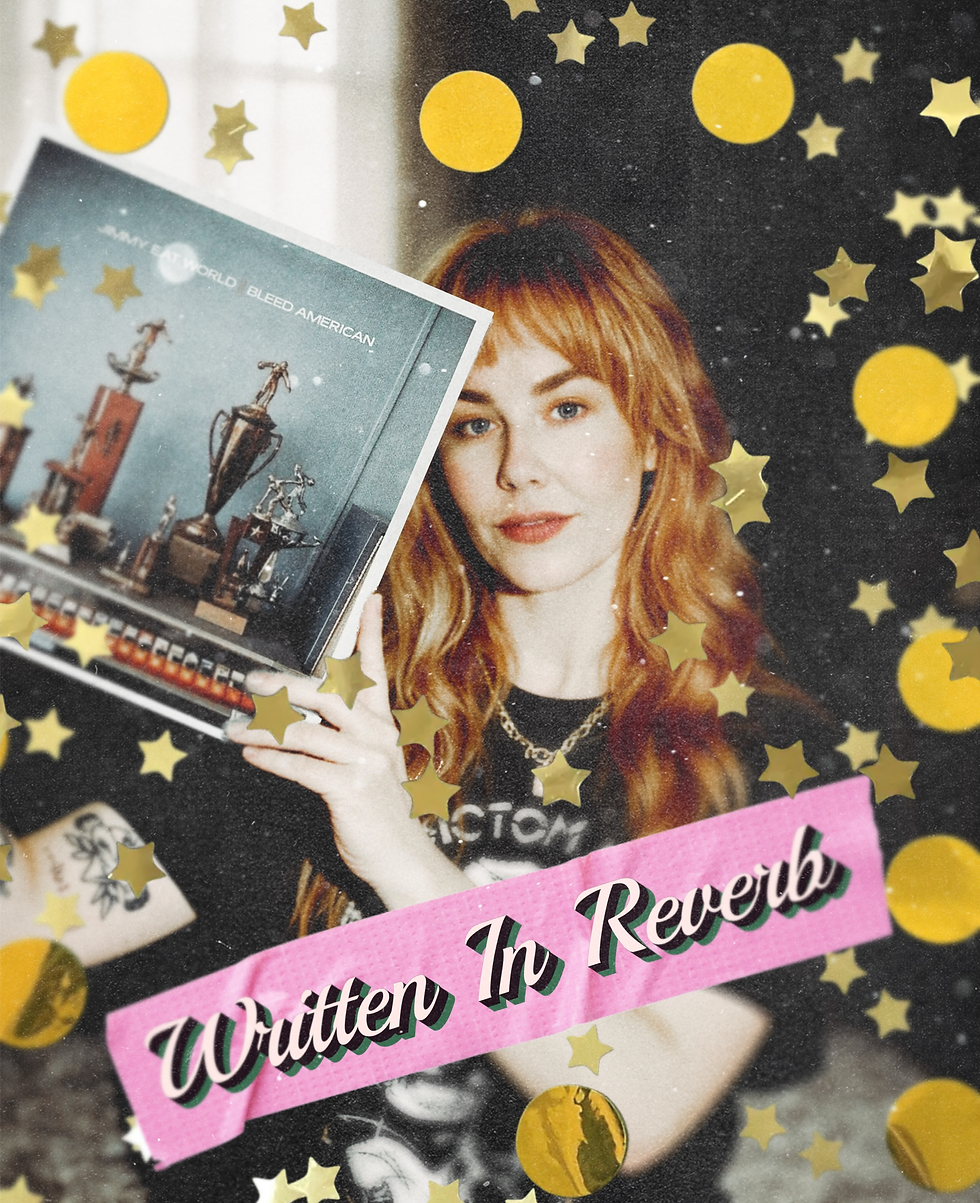
I first heard Jimmy Eat World hanging out with my skateboarding buddies, passing around a scratched-up Misc Disc that had a few Clarity tracks on it. It wasn’t even labeled—just “J.E.W.” scrawled in Sharpie like some sacred relic of teenage rebellion. As soon as the songs started, something clicked. I’d heard this before. Not just the guitars, not just Jim’s voice, but the feeling. Turns out, I knew those songs from One Tree Hill.
Yeah. That show.
Say what you will, but One Tree Hill was wildly influential, especially if you were a little too emotional, a little too into band tees(god, I still am) and a little too convinced that your life had a soundtrack. The music supervision on that show introduced an entire generation to emo, indie, and alt-rock that felt like it was written just for them. It turned background music into emotional canon.
So there I was: a kid with scuffed-up Chuck Taylors and a brand spanking new Weezer t-shirt, catching feelings in the middle of a skate session because a TV drama cracked open my musical brain. That’s the power of discovery. That’s how this band starts to mean something. Not all at once, but in little moments - when you realize the songs already live inside you.
The title track kicks the door down in under three seconds: drums like bright fists on a garage roof, guitars that feel like fluorescent lights flickering on, and Jim Adkins announcing himself with a line that still feels like caffeine to the bloodstream. It’s fast, fearless and so exceptionally catchy…might as well call it viral. This is the thesis of the record: melody as catharsis, volume as therapy.
“A Praise Chorus” THE permission slip to live again. I have many thoughts and many words that I shamelessly share with everyone who would listen. It’s the heartbeat of the album (and the Davey von Bohlen magic) If Bleed American is the engine, “A Praise Chorus” is the adrenaline shot: an ecstatic push toward life, movement, momentum. It’s a song that feels like someone grabbing your wrist right before you talk yourself out of feeling happy.
Where most albums bury their existential revelations in track nine or ten, Jimmy Eat World does the opposite. They put it right near the front. They hand you a manifesto. You just gotta be brave enough or reckless enough to follow.
This is one of the best songs in the world. It’s the moment childhood nostalgia meets adult urgency. It’s a pep talk disguised as a Midwest rock/emo anthem. It’s the sound of refusing stagnation.
“Are you gonna live your life wondering…?” Jim Adkins sings it like he’s already lived through the hesitation. And then, with perfect timing, comes the voice that pushes the door all the way open. Enter Davey Von Bohlen (The Promise Ring, Cap’n Jazz). I was a huge teenage Promise Ring fan. This one’s sacred for me.
To understand why this feature matters, you have to understand what Davey represents. Before Bleed American, emo wasn’t mainstream radio. It wasn’t TV-ready. It was sweaty basements, photocopied flyers, too-loud guitars, and lyrical vulnerability that felt almost embarrassing to admit out loud. The Promise Ring was one of the bands that built that world.
Davey steps in during the outro, almost like the ghost of every mixtape you made in high school. He sings lines referencing the songs that made you: “…Crimson and clover, over and over…”
“…Our house in the middle of the street…” A coded message from the scene to the wider world.…”Come on Davey, sing me something that I know”
He becomes the narrator of nostalgia itself. In that moment, the song becomes a metaverse in the most beautiful way: It’s a praise chorus about praise choruses. It’s a celebration of the songs that saved you, sung by a man whose own songs once saved the ones making this album. Jimmy Eat World built their breakout record by inviting their roots into the spotlight. Davey’s presence says: “We came from this. We honor this. We are nothing without the songs that carried us here.”
I think that the whole point of “A Praise Chorus” is that movement is salvation.
That “stuck” is just a temporary state, not a destiny. Davey’s cameo underscores that the way out is often found in the art you once loved. The songs that made you feel alive. The ones that made you start. And it remains, in every sense, one of the most meaningful features in modern rock history.
“The Middle” is universal without ever being generic. Possibly one of the most famous pep talks in rock history, and still one of the most generous. The brilliance is its simplicity: three chords, clean guitars, and a message that outlived the early-2000s emo boom. You don’t need to be sixteen to feel seen by this song. You just need to be human.
The beauty of “Sweetness”, a dopamine detonation, a perfect singalong. The call-and-response hook. The palm-muted tension before the chorus explodes. The way crowds still scream “Are you listening?” like they’re begging the universe for a sign. This song is engineered for sweaty venues, road trips, windows down.
“Hear You Me” holds your hand and shows you how grief turns into grace. This is the emotional spine of the album. A song that doesn’t try to fix loss, only holds it with reverence. Those harmonies, that slow build, the way the lyric “May angels lead you in” feels like a blessing and a goodbye. Jimmy Eat World has always written sadness with astonishing hospitality: you’re not crushed by it, you’re accompanied.
Tucked deep in the tracklist, “Authority Song” is a sleeper hit, like if “A Praise Chorus” had a punk-rock twin who listened to Henry Rollins and slammed doors. It’s bratty in the best way: defiant, driving, and full of restless energy. Lyrically, it plays out like a mini-anthem for anyone who’s ever questioned the rules, the plan, or the whole damn system and thought: “Nah, I’ll figure it out myself.”
The title, of course, nods to John Mellencamp’s track of the same name, but this one’s less bar-band bravado, more internal monologue on loop. The riff is punchy, the pace relentless, and Adkins delivers every line with the tight-jawed urgency of someone who’s been told to calm down one too many times.
It’s a perfect middle finger wrapped in a melody. And on an album so concerned with movement and self-definition, “Authority Song” is crucial, - it’s the tension point. The voice in your head that says, you don’t have to play by the rules if the rules never worked for you. Oh baby, I listen.
Front-to-back, no skips
Here’s the secret reason why
is one of the best albums in the world: it has no dead weight.
Not a filler, not a misstep, not a song that feels like an intermission. Every track is a melody with purpose, every arrangement is lean, every lyric carries enough emotional charge to spark recognition in anyone who hears it.
Many bands wrote great songs in the early 2000s. Jimmy Eat World wrote an album: a cohesive, shimmering, perfectly sequenced piece of work that bridges pop, punk, alt-rock, and emo without ever being trapped by any of them. It’s clean but never sterile, emotional but never indulgent, catchy but never cheap.
It’s one of the best albums ever because it doesn’t age, it grows. And every time you put it on, it gives you the exact thing you didn’t know you needed. It manages the rare miracle of being both timeless and deeply of its time. Most albums want to matter.
This one already does. And if you’ve ever screamed “Sweetness” in a car at midnight, cried to “Hear You Me,” or felt “The Middle” pull you out of your own darkness, then you know:
Bleed American isn’t just a classic.
It’s a compass. A comfort. A spark.
One of the best albums ever made.
Don’t waste it. Spin it in full. Spin it loud. Sing along.


Comments